
Summary: A bunch of people way smarter than me decided to build a giant bomb and created a city and lab out in New Mexico to do it.
I certainly hope they added some nudity to spice up the movie.
WWII and nuclear holocaust just won't sell tickets


Follow along with the video below to see how to install our site as a web app on your home screen.
Note: This feature may not be available in some browsers.
Summary: A bunch of people way smarter than me decided to build a giant bomb and created a city and lab out in New Mexico to do it.
My Dad weighed around 100 pounds in the evac hospital. Not sure how he carried his gun and pack.I mentioned this somewhere else, maybe in a different thread, maybe earlier in this one, but after having seen both "Band of Brothers" and then "The Pacific", and even knowing that those shows for as well done as they were can only be so realistic up to a point, that there is no doubt in my mind that if I could have made the choice at the time as an 18-year old kid in 1942/1943 that I would have signed up for the European theaters of war after seeing how brutal and bloody the island-hopping battles in the Pacific were.

I read that the casualty rate among bomber crews was high enough that you were pretty unlikely to survive your tour of duty.Not a sequel or anything, but if anybody is curious about the parallel Soviet nuclear weapons program running at the same time as the Manhattan Project, this book is an excellent tale:
Stalin and the Bomb
Which theater was "easier" depends on what you were doing.
I wouldn't have wanted to have been a solider or Marine involved in the war of attrition on Guadalcanal or during the island-hopping campaign across the central Pacific to Okinawa.
But if I was in the USAAC, I would have much rather been in the Pacific. Flying B-29s at high altitude with minimal Japanese interception and AAA fire and hanging out on sandy beaches between missions sounds positively cushy compared to what the air war over Europe was like for bomber crews.
I don't know how well I would have done cooped up in a submarine for months at a time in the Pacific, too, terrified one mechanical failure could send me past crush depth at any given moment.

I read that the casualty rate among bomber crews was high enough that you were pretty unlikely to survive your tour of duty.

Memphis Belle is a solid war movie about a bomber crew in Europe if you haven't seen it.I read that the casualty rate among bomber crews was high enough that you were pretty unlikely to survive your tour of duty.

You should probably read Unbroken about the life of Louis Zamperini and what he endured lost at sea for over a month after his bomber went down and then his stay in a Japanese POW camp. It wasn't all safe missions and sandy beaches in the Pacific either.Not a sequel or anything, but if anybody is curious about the parallel Soviet nuclear weapons program running at the same time as the Manhattan Project, this book is an excellent tale:
Stalin and the Bomb
Which theater was "easier" depends on what you were doing.
I wouldn't have wanted to have been a solider or Marine involved in the war of attrition on Guadalcanal or during the island-hopping campaign across the central Pacific to Okinawa.
But if I was in the USAAC, I would have much rather been in the Pacific. Flying B-29s at high altitude with minimal Japanese interception and AAA fire and hanging out on sandy beaches between missions sounds positively cushy compared to what the air war over Europe was like for bomber crews.
I don't know how well I would have done cooped up in a submarine for months at a time in the Pacific, too, terrified one mechanical failure could send me past crush depth at any given moment.

Great bookYou should probably read Unbroken about the life of Louis Zamperini and what he endured lost at sea for over a month after his bomber went down and then his stay in a Japanese POW camp. It wasn't all safe missions and sandy beaches in the Pacific either.
You should probably read Unbroken about the life of Louis Zamperini and what he endured lost at sea for over a month after his bomber went down and then his stay in a Japanese POW camp. It wasn't all safe missions and sandy beaches in the Pacific either.


It's really great because it's almost broken down into 4 parts: 1. His childhood, becoming an elite runner, and running at the Berlin Olympics 2. Joining the military, crashing, and surviving weeks at sea 3. Being a POW and surviving the brutal Japanese camps 4. His comeback to running and his postwar life. It's really a great book. The movie doesn't do it justice at all.I’ve not read that particular one but have read plenty of other accounts of being a POW of the Japanese. It wasn’t fun, obviously. But playing the odds… you’d want to fly in the Pacific. Japanese air power and AAA against high-altitude bombers was minimal compared to what the Germans were throwing at them.

Although it sounds like his work in the trailer, Hans Zimmer did not compose the music for this.
Yep!
Also, the U.S. sent Japan communiques stating that the U.S. was in possession of weapons of such terrible destructive power and were prepared to use them without a full surrender. Japan was given a very fair chance to avoid the destruction, but they chose to ignore warnings. Culturally, surrender just wasn’t something Japan could do… until sadly, two cities were vaporized, innocent lives lost, and even more innocent lives altered forever. Japan had been unbowed through centuries of conflict, but this wound was too great to preserver further.
The likely other path was U.S. troops in pitched combat with what remaining army Japan had and women and children. Terrible choice either way.
German submarine crews might ask you to hold their beer, as might a few others. Although I agree making it through 25 missions was a challenge.Roughly 45% were killed.
Another 5% wounded (notice this was a low rate... not many limped away from a crash).
Another 5% captured.
So roughly flip a coin if you'd make it through your 25 missions.
Nothing else was even close in terms of casualty rate.
German submarine crews might ask you to hold their beer, as might a few others. Although I agree making it through 25 missions was a challenge.
My wife's late stepgrandfather was a submariner in the Pacific.
He was perfectly willing to talk about his experience in the war but he said there wasn't much to tell for him. Just months at a time in a tin can never seeing the sun working on the power plant.
He told me he never really knew what was going on with the weapons room at the front or on the bridge. His engineering officer strongly discouraged any thoughts about anything but their immediate duties. All he was concerned with was the smell of diesel and being covered in grease all the time.
He'd only know they were in combat when he heard the compressed air "THWUMP" of a torpedo launch.
Then don't watch Das Boot.This makes me claustrophobic just reading it.
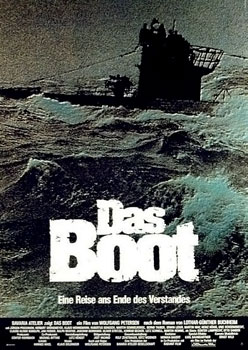
I'm not sure on the casualty rate of US subs overall, but German U-boat had a 75% casualty rate. https://historyincharts.com/german-u-boat-losses-in-world-war-ii/. I believe that--beyond small units which were sometimes wiped out--this was the highest casualty rate of any broad classification of service in WW II.My wife's late stepgrandfather was a submariner in the Pacific.
He was perfectly willing to talk about his experience in the war but he said there wasn't much to tell for him. Just months at a time in a tin can never seeing the sun working on the power plant.
He told me he never really knew what was going on with the weapons room at the front or on the bridge. His engineering officer strongly discouraged any thoughts about anything but their immediate duties. All he was concerned with was the smell of diesel and being covered in grease all the time.
He'd only know they were in combat when he heard the compressed air "THWUMP" of a torpedo launch.


