
So if I am trying to determine how this affects the property tax on a house, can I simply use the rate in cell 72 and rank the cities by that?spreadsheet this seems to work
https://dom.iowa.gov/document/individual-tax-levies-all-cities-2002-2019


No forums found...
Site Related
Iowa State
College Sports
General - Non ISU
CF Archive
Install the app
How to install the app on iOS
Follow along with the video below to see how to install our site as a web app on your home screen.
Note: This feature may not be available in some browsers.
Property Tax Increase
- Thread starter spierceisu
- Start date
No forums found...
Site Related
Iowa State
College Sports
General - Non ISU
CF Archive
You are using an out of date browser. It may not display this or other websites correctly.
You should upgrade or use an alternative browser.
You should upgrade or use an alternative browser.

Does that spreadsheet show school district levies? I didn't see it, but maybe I missed it. That's a pretty good chunk of your property taxes.


There was another one posted earlier than was a little different and ranked them all by the total.
Edit: found it
https://dom.iowa.gov/document/consolidated-tax-rate-comparison-between-cities
Edit: found it
https://dom.iowa.gov/document/consolidated-tax-rate-comparison-between-cities

Explain European cities then. They are far more dense and have the same problems.
First off, I don't know that European cities do have the same problems. You'd need to give me a source to that. I would say if any adopted the experimental suburban development patterns that we generally did across the board here in the US post WWII, then they would have similar issues.
Cities can have financial problems for other reasons as well. I would GUESS that if there are examples of European cities struggling financially, it might have more to do with unrealistic commitments to social/public programs vs their development pattern. That said, it is a lot easier cutting back programs vs telling already established neighborhoods that the city is privatizing their cul de sac because it only services a handful of houses with 1/2 acre lots and is drain on the resources given their property taxes don't cover the costs to keep as city street. That won't go over well.
First off, I don't know that European cities do have the same problems. You'd need to give me a source to that. I would say if any adopted the experimental suburban development patterns that we generally did across the board here in the US post WWII, then they would have similar issues.
Cities can have financial problems for other reasons as well. I would GUESS that if there are examples of European cities struggling financially, it might have more to do with unrealistic commitments to social/public programs vs their development pattern. That said, it is a lot easier cutting back programs vs telling already established neighborhoods that the city is privatizing their cul de sac because it only services a handful of houses with 1/2 acre lots and is drain on the resources given their property taxes don't cover the costs to keep as city street. That won't go over well.
The bottom line is they run into problems due to mismanagement and socialistic policies running out of OPM. You can look at the Yellow Vests in France for a broad example. Italy, Greece, etc but those are on a national level.
There is tons of info available on the US but very little from Europe. Which is interesting in itself but does not mean they are just a ok.
Based on this link, here is how some random towns between Ames-DSM rank using 400k assessedThere was another one posted earlier than was a little different and ranked them all by the total.
Edit: found it
https://dom.iowa.gov/document/consolidated-tax-rate-comparison-between-cities


The bottom line is they run into problems due to mismanagement and socialistic policies running out of OPM. You can look at the Yellow Vests in France for a broad example. Italy, Greece, etc but those are on a national level.
There is tons of info available on the US but very little from Europe. Which is interesting in itself but does not mean they are just a ok.
I didn't claim they were "just ok", I'm just not that interested in European cities specific financial situations as 1) they don't affect me directly, and 2) they are different enough, generally speaking, than the average US city so they are not real useful in making comparisons.
Bottomline: we have our own issues and people are mad about property taxes but aren't generally aware of the landscape of how or why we got here. It is complex enough so muddying the discussion by bringing in European cities doesn't seem to me to be a productive avenue to the discussion IMO. Those that have honestly looked into this have identified the problem (not enough property tax producing building per acre) , and it isn't an easy fix when you're talking about what is already built/established. .
I didn't claim they were "just ok", I'm just not that interested in European cities specific financial situations as 1) they don't affect me directly, and 2) they are different enough, generally speaking, than the average US city so they are not real useful in making comparisons.
Bottomline: we have our own issues and people are mad about property taxes but aren't generally aware of the landscape of how or why we got here. It is complex enough so muddying the discussion by bringing in European cities doesn't seem to me to be a productive avenue to the discussion IMO. Those that have honestly looked into this have identified the problem (not enough property tax producing building per acre) , and it isn't an easy fix when you're talking about what is already built/established. .
You have a long history with cities that are exactly as you desire. Seems like a great place to study. I lived in a city in Germany that had several hundred thousand residents and I walked virtually the entire town from south to north in about an hour. They even had a subway where the stops were about 3-5 mins apart walking in a few places. Kinda pointless.but expensive.

I didn't claim they were "just ok", I'm just not that interested in European cities specific financial situations as 1) they don't affect me directly, and 2) they are different enough, generally speaking, than the average US city so they are not real useful in making comparisons.
Bottomline: we have our own issues and people are mad about property taxes but aren't generally aware of the landscape of how or why we got here. It is complex enough so muddying the discussion by bringing in European cities doesn't seem to me to be a productive avenue to the discussion IMO. Those that have honestly looked into this have identified the problem (not enough property tax producing building per acre) , and it isn't an easy fix when you're talking about what is already built/established. .
In the town I live, they have stolen water/sewer money to keep taxes lower. Now the water tower is almost shot and they have no funds and are cranking the rates up to catch up. I believe towns should move money around. Make each area stand on its own and let people know what they are truly paying for.
In the town I live, they have stolen water/sewer money to keep taxes lower. Now the water tower is almost shot and they have no funds and are cranking the rates up to catch up. I believe towns should move money around. Make each area stand on its own and let people know what they are truly paying for.
Most of these towns are run by people who mean well but don't have any experience or ability to manage. Some would have trouble managing a bubble gum machine.
In the town I live, they have stolen water/sewer money to keep taxes lower. Now the water tower is almost shot and they have no funds and are cranking the rates up to catch up. I believe towns should move money around. Make each area stand on its own and let people know what they are truly paying for.
That would truly be an eye-opener for many. There is a company called Urban3 that does analysis for cities that breaks down by neighborhood what the city is receiving per acre in property taxes. It often shows that the older, poorer neighborhoods often are subsidizing the newer more wealthy neighborhoods on the outskirts of cities. This happens because the older neighborhoods are built in a traditional style (street grid system, narrower streets, houses built closer to each other, multi-storied buildings present, etc. while the new ones, are in a suburban style - wide non-thru streets, houses farther apart, business districts with single story buildings with huge parking lots, etc.
That would truly be an eye-opener for many. There is a company called Urban3 that does analysis for cities that breaks down by neighborhood what the city is receiving per acre in property taxes. It often shows that the older, poorer neighborhoods often are subsidizing the newer more wealthy neighborhoods on the outskirts of cities. This happens because the older neighborhoods are built in a traditional style (street grid system, narrower streets, houses built closer to each other, multi-storied buildings present, etc. while the new ones, are in a suburban style - wide non-thru streets, houses farther apart, business districts with single story buildings with huge parking lots, etc.
Now split the costs up per acre. A pretty useless statistic.
Now split the costs up per acre. A pretty useless statistic.
Maybe I'm not following your point, but adding in a cost analogy would seem to just amplify the disparity. (pls correct me if I"m missing your point)
i.e...if you look at a city block built in the traditional style vs a city block (same length) in the post-WWII "suburban" style, you'll find that the latter is most likely producing less per acre in tax revenue (since it is more spread out) which was my original point. You are now adding to the discussion "costs". Well...the latter also probably has more expensive streets because they are wider, and the underground infrastructure probably costs the same, but it services far fewer houses/buildings in each block so the costs per property paying entity is more there too.
note: people often come back with -- "but I don't want to live downtown!" but there are plenty of traditionally built neighborhoods (even in places like older parts of Ankeny) you could use as examples of what I'm referring to as "traditional".
Not may favorite example because the thread is on residential property taxes, but it is all I could find and I think it still illustrates the larger point why cities, despite the appearance of prosperity and years of growth, are finding they need additional revenue to meet obligations.
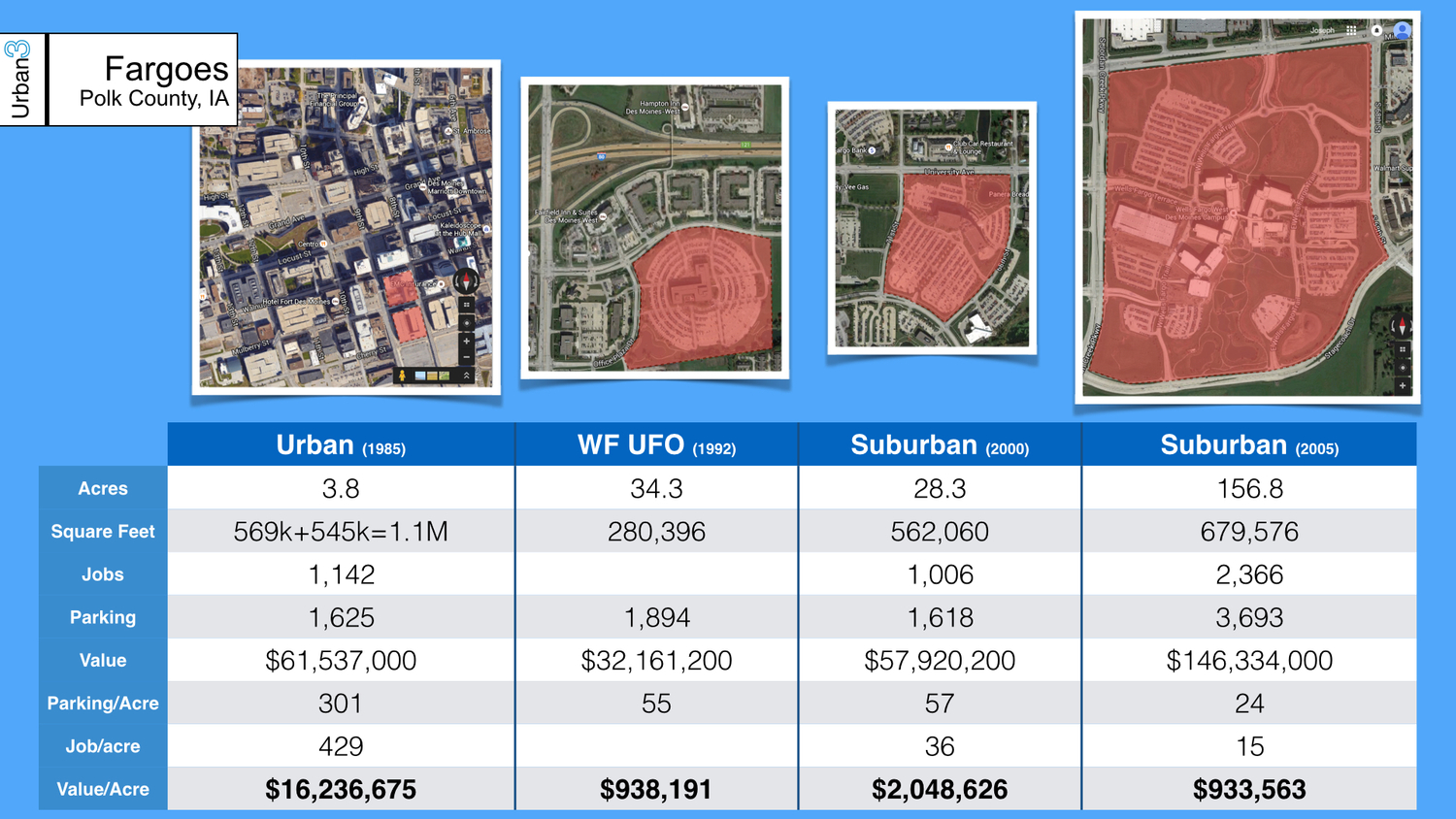
Four different Wells Fargo "campuses" in metro Des Mooines. One on the left is located in a traditionally built style (pre-WWII style), the other three are suburban. (Being generous to the 3 to the right) All 4 require approximately the same amount of above and below ground public infrastructure to service them, but look how much more bang for the buck you get in a traditionally developed office vs suburban.
Land is valuable. Infrastructure to support what is built on it is expensive. Is it any wonder our cities are hurting to try and figure out how they are going to pay to maintain everything? The last line, "Value/Acre" is most telling. This is what drives what these pieces of property pay in taxes for the land they are occupying.
http://www.arcgis.com/apps/MapJournal/index.html?appid=11cc819544c347cab87fcb8a7c9846e2
Four different Wells Fargo "campuses" in metro Des Mooines. One on the left is located in a traditionally built style (pre-WWII style), the other three are suburban. (Being generous to the 3 to the right) All 4 require approximately the same amount of above and below ground public infrastructure to service them, but look how much more bang for the buck you get in a traditionally developed office vs suburban.
Land is valuable. Infrastructure to support what is built on it is expensive. Is it any wonder our cities are hurting to try and figure out how they are going to pay to maintain everything? The last line, "Value/Acre" is most telling. This is what drives what these pieces of property pay in taxes for the land they are occupying.
http://www.arcgis.com/apps/MapJournal/index.html?appid=11cc819544c347cab87fcb8a7c9846e2
Maybe I'm not following your point, but adding in a cost analogy would seem to just amplify the disparity. (pls correct me if I"m missing your point)
i.e...if you look at a city block built in the traditional style vs a city block (same length) in the post-WWII "suburban" style, you'll find that the latter is most likely producing less per acre in tax revenue (since it is more spread out) which was my original point. You are now adding to the discussion "costs". Well...the latter also probably has more expensive streets because they are wider, and the underground infrastructure probably costs the same, but it services far fewer houses/buildings in each block so the costs per property paying entity is more there too.
note: people often come back with -- "but I don't want to live downtown!" but there are plenty of traditionally built neighborhoods (even in places like older parts of Ankeny) you could use as examples of what I'm referring to as "traditional".
Revenue per acre is a pretty useless stat. Unless the Cities are constrained by the number of acres they cover. Does it increase the costs of infrastructure, yes, but it's such a small amount as to not worry. Other costs far outweigh any additional infrastructure costs. If you don't want to take the risk then let them form HOA's and maintain the streets and utilities.
Not may favorite example because the thread is on residential property taxes, but it is all I could find and I think it still illustrates the larger point why cities, despite the appearance of prosperity and years of growth, are finding they need additional revenue to meet obligations.
Four different Wells Fargo "campuses" in metro Des Mooines. One on the left is located in a traditionally built style (pre-WWII style), the other three are suburban. (Being generous to the 3 to the right) All 4 require approximately the same amount of above and below ground public infrastructure to service them, but look how much more bang for the buck you get in a traditionally developed office vs suburban.
Land is valuable. Infrastructure to support what is built on it is expensive. Is it any wonder our cities are hurting to try and figure out how they are going to pay to maintain everything? The last line, "Value/Acre" is most telling. This is what drives what these pieces of property pay in taxes for the land they are occupying.
http://www.arcgis.com/apps/MapJournal/index.html?appid=11cc819544c347cab87fcb8a7c9846e2
The density isn't what makes the land valuable. The land becomes more valueable (due to the location) and then it is improved accordingly.
When you do any sort of appraisal you really have to do two separate appraisals. You have to estimate what the value of the land is, and then value the improvements separately. Lots of appraisers will screw this up and it leads to Highest & Best Use errors in towns that actually have some growth.
Last edited:
Revenue per acre is a pretty useless stat. Unless the Cities are constrained by the number of acres they cover. Does it increase the costs of infrastructure, yes, but it's such a small amount as to not worry. Other costs far outweigh any additional infrastructure costs. If you don't want to take the risk then let them form HOA's and maintain the streets and utilities.
What (see bolded)? What are you basing that on because I can provide plenty of case studies that illustrate it makes a huge difference.
Last edited:
The density isn't what makes the land valuable. The land becomes more valueable (due to the location) and then it is improved accordingly.
When you do any sort of appraisal you really have to do two separate appraisals. You have to estimate what the value of the land is, and then value the improvements separately. Lots of appraisers will screw this up and it leads to Highest & Best Use errors in towns that actually have some growth.
Again...this is the second time you've made a claim implying it was a point I was making (and it wasn't) and then refuted it. You are talking past what I am trying to discuss, instead of addressing what I'm saying head on. I'm not trying to be an ass, but I'm not going to hand-hold the conversation much longer if you aren't interesting in engaging honestly/directly. This is a dollar and cents conversation....it can be very productive.....but at the rate you and I are going, it isn't heading that way. (I'll grant some space for that fact that maybe I'm doing a lousy job making my point(s)>"
The dollar figures in the Wells Fargo example are of public record. These aren't hypotheticals. These are black and white examples of how different development styles essentially do or don't pay for their existence.
What (see bolded)? What are you basing that on because I can provide plenty of case studies that illustrate it makes a huge difference.
Look through the property tax levy data. The general fund has been fixed (as a % not gross revenue) for a long time in Iowa but the amount cities spend on roads and what sewers is not a large percentage. Plus how do you explain a lot of the newer developments that have HOA's that own and maintain the infrastructure.